Secondary Suite Renovation Cost in Vancouver (2026)

Secondary Suite Renovation Cost in Vancouver (2026)

A complete cost guide for Vancouver homeowners planning a legal basement suite in 2026 – including permit steps, CMHC financing, and ROI.

Metro Vancouver’s rental vacancy rate sits at under 1%. The average basement suite in East Vancouver rents for $2,100 to $2,400 a month. And with the BC government’s push to legalize more housing units through Bill 44, the window to add a secondary suite – and start earning income from your existing home – has never been more wide open.

For many Vancouver homeowners, a secondary suite is the only renovation that can pay for itself. But before you start knocking down drywall, you need to know the real numbers: what it costs, what the permit process looks like, and how to avoid the mistakes that turn a $80,000 project into a $140,000 one.

This guide covers everything you need to know about secondary suite renovation costs in Vancouver in 2026.

What Is a Secondary Suite?

A secondary suite is a self-contained dwelling unit located within the principal structure of your home – think a basement apartment with its own kitchen, bathroom, living area, and separate entrance. It’s not a laneway house (which is a detached structure on your property) and it’s not an unauthorized “mortgage helper” tucked behind a curtain wall. A legal secondary suite meets the BC Building Code and has been permitted by your municipality.

Under the BC Building Code, a secondary suite cannot exceed 90 m² (about 968 sq ft), and it cannot take up more than 40% of the home’s total habitable floor space. It must be located within the principal dwelling – in most Vancouver homes, that means the basement.

Homeowners add secondary suites for three main reasons: rental income to offset the mortgage, multigenerational living (parents, adult children, in-laws), and resale value. In Metro Vancouver’s market, all three are compelling. But the ROI math only works if the suite is done legally – more on that later.

Secondary Suite Renovation Cost in Vancouver — The Short Answer

Here’s the honest range for a secondary suite renovation in Metro Vancouver in 2026:

ScenarioLow estimateHigh estimate
Basic conversion (good existing basement – 7’+ ceiling, plumbing nearby)$60,000$80,000
Mid-range (some plumbing/electrical upgrades needed, average-condition basement)$80,000$120,000
High-end or full gut (low ceilings, underpinning required, older home)$120,000$200,000+

These figures assume a basement conversion of roughly 500 to 800 sq ft in Metro Vancouver. At the cost-per-square-foot level, a legal suite typically runs $100 to $250 per square foot – higher than a standard basement renovation because of the additional requirements for fire separation, a separate electrical subpanel, and code-compliant plumbing.

The single biggest cost variable is what’s already there. A Vancouver Special built in the 1970s with an 8-foot basement, a nearby plumbing stack, and a 200-amp panel is a very different project from a 1940s bungalow with a 6-foot crawl space and a 100-amp fuse box. Before you budget, you need to know which one you’re working with.

The 6 Biggest Cost Drivers

1. Ceiling Height and Underpinning

The BC Building Code requires a minimum ceiling height of 6’5″ over at least 80% of the suite’s habitable floor area and over all exit routes. If your basement falls short, you have two choices: underpin (lower the floor) or walk away from the project.

Underpinning involves excavating below the existing foundation footings to lower the basement floor, then reinforcing the footings to carry the new load. It’s structural work and it’s expensive:

  • Underpinning cost in Vancouver: typically $30,000 to $70,000 depending on the perimeter length, soil conditions, and access
  • Bench-footing (an alternative method for smaller depth increases): $15,000 to $35,000, but eats into the floor area

If your home was built before 1950, assume you’ll need underpinning until a structural engineer tells you otherwise. Post-1970 Vancouver Specials almost always have sufficient ceiling height – it’s one of the reasons they’re so commonly converted.

2. Plumbing

A secondary suite requires a full kitchen and bathroom where, in most cases, only rough plumbing exists or none at all. New drain lines, venting, supply lines, and possibly a sewage ejector pump (if the suite sits below the city sewer line) all add up:

  • New bathroom rough-in: $5,000 to $10,000
  • Kitchen plumbing addition: $3,000 to $8,000
  • Sewage ejector pump (if required): $3,000 to $6,000

All plumbing must be done by a licensed plumber who pulls a permit. Homeowner permits are not available for secondary suite work – this is non-negotiable.

3. Electrical

A legal secondary suite requires its own electrical subpanel, metered separately from the main unit. If your home has a 100-amp panel – common in homes built before 1980 – it will need to be upgraded before a subpanel can be added.

  • Panel upgrade (100A to 200A): $3,000 to $6,000
  • Suite subpanel and wiring: $6,000 to $12,000
  • Interconnected smoke and CO detector system: $1,000 to $2,500

The electrical work must be done by a licensed electrician and inspected before walls are closed. All bedrooms require arc-fault protection; bathrooms require ground-fault protection.

4. Fire Separation

This is the requirement most homeowners don’t anticipate. The BC Building Code mandates a 1-hour fire-rated assembly between the secondary suite and the main dwelling – typically two layers of 5/8″ Type X drywall on the ceiling of the suite and fire-rated partitions along any shared wall. Fire blocking must be installed at all penetrations (electrical, plumbing, HVAC).

This isn’t optional and it isn’t decorative. It’s inspected. Expect to budget $3,000 to $8,000 for fire separation materials and labour, depending on how much of the ceiling and wall area needs to be rebuilt.

5. Separate Entrance

Every legal suite needs a separate, direct entrance to the exterior – not a shared corridor or a door through the garage. If your home already has a side door or a walk-out rear, you may already be most of the way there. If not, a new entrance involves:

  • Structural framing for the door opening: $1,500 to $3,000
  • Exterior door, weatherproofing, and exterior steps: $2,000 to $5,000
  • Excavation for a below-grade entrance or window well stairwell: $5,000 to $15,000

For many older Vancouver homes with below-grade basements, a new side entrance through a window well is the most cost-effective path.

6. Finishes and Fit-Out

Once the structure, mechanical, and fire separation work is done, you still need a liveable suite: flooring, kitchen cabinetry and countertops, appliances, bathroom fixtures and tile, lighting, and paint.

  • Kitchen (cabinets, counters, appliances): $8,000 to $20,000
  • Bathroom (tile, vanity, fixtures): $5,000 to $12,000
  • Flooring (LVP or tile throughout): $3,000 to $7,000
  • Lighting, paint, trim: $2,000 to $5,000

One practical note: rental suites take more wear than owner-occupied spaces. Spend money on durability – LVP flooring over hardwood, quartz over laminate counters, solid-core doors. You’ll recoup it in lower maintenance costs and longer intervals between refreshes.

Vancouver Secondary Suite Permit Requirements

Here’s the section most homeowners skip – and the one that causes the most expensive problems. An unpermitted suite is not just illegal. It doesn’t add measurable value at resale. It creates gaps in your home insurance. And if the City of Vancouver discovers it, you’re looking at stop-work orders, fines, and potentially the cost of removing everything you’ve built.

Do it properly. The permit process is not as daunting as it sounds.

Step 1: Confirm Your Zoning

The City of Vancouver allows one secondary suite per single-family lot in RS (Residential) and RT (Residential Two-Family) zones – which covers the vast majority of detached and semi-detached homes in Vancouver. You can confirm your zoning using the City’s online property map at vancouver.ca, or by calling 3-1-1.

If your property is in Burnaby, Richmond, North Vancouver, or another Metro municipality, the rules are similar but not identical. Burnaby, for example, requires a minimum lot size of 4,000 sq ft for a suite. It’s worth a call to your local building department before you start.

Step 2: Get Your Drawings Done

You’ll need architectural drawings to apply for a building permit. These show the layout of the proposed suite, the fire separation details, the egress windows, the electrical panel location, and the entrance. A residential designer or architect typically charges $2,000 to $5,000 for secondary suite drawings in Vancouver.

The City requires that drawings demonstrate compliance with the BC Building Code before it will accept a permit application. Getting the drawings right the first time saves weeks of back-and-forth.

Step 3: Apply for Permits

A secondary suite requires three separate permits:

  1. Development permit (zoning compliance): $300 to $600
  2. Building permit (construction): $1,200 to $2,400 depending on project value
  3. Electrical and plumbing permits (pulled by your licensed contractors): $400 to $800 combined

Total permit costs typically run $2,000 to $4,000, not including the drawings.

Permit approval currently takes three to six months in Vancouver. This is the most common cause of project delays – homeowners underestimate the approval timeline and then try to accelerate the construction phase, which leads to inspection failures. Start the permit process before you demo anything.

BC Building Code Requirements Checklist

Your suite must meet all of the following to pass inspection:

Minimum 6’5″ ceiling height in habitable rooms
Separate entrance to the exterior (not through shared space)
Full kitchen (sink, stove, refrigerator) and bathroom
1-hour fire-rated assembly between suite and main dwelling
Egress window in each bedroom (minimum opening size per BC Building Code)
Separate electrical subpanel, accessible from within the suite
Interconnected smoke and CO detectors with the main unit
Minimum 400 sq ft floor area, maximum 968 sq ft (40% of habitable space)
Compliant plumbing with proper venting and drainage

CMHC Secondary Suite Loan and Other Financial Programs

Here’s something many Vancouver homeowners don’t know: the federal government offers a dedicated financing program for exactly this project. The CMHC Secondary Suite Loan provides up to $80,000 at a fixed 2% interest rate for owner-occupied homes adding a legal secondary suite.

To put that in perspective: in early 2026, most HELOCs are running at prime plus 0.5 to 1.0% – roughly 6.2 to 6.5%. The CMHC loan is more than three times cheaper. If your project costs $70,000 to $80,000, financing it through the CMHC loan rather than a HELOC saves you $10,000 to $15,000 in interest over a five-year payback period.

Eligibility requirements include:

  • Owner-occupied home
  • The suite must be a new legal unit (not legalizing an existing illegal suite – although a companion program may apply in that case)
  • Household income under the program threshold (confirm current limits at CMHC.ca)
  • The suite must comply with applicable zoning and building codes
The numbers in practice A $75,000 suite financed entirely through the CMHC Secondary Suite Loan at 2% costs approximately $650/month to repay over 10 years. A legal East Vancouver basement suite rents for $2,100 to $2,400/month. The suite pays off the loan in approximately three years – and then generates pure income.

Stacking Programs for Energy Upgrades

If your secondary suite project includes energy-efficiency upgrades – insulation, windows, a heat pump – you may be eligible to stack additional rebates and subsidized financing:

  • CleanBC Better Homes: up to $15,000 in rebates for heat pumps, insulation, and window upgrades
  • Canada Greener Homes Grant: up to $5,600 in grants plus a 0% loan for eligible upgrades
  • BC Hydro and FortisBC rebates: $500 to $3,000 depending on the equipment installed

Stacking these programs on a project that includes a heat pump and basement insulation upgrade can reduce your out-of-pocket cost by $20,000 to $35,000. The catch: you need an energy advisor assessment before and after work, and the upgrades must be done by registered contractors. Talk to your contractor about sequencing this properly.

What’s the Return on Investment?

The secondary suite is, by a significant margin, the highest-ROI renovation in Metro Vancouver. Here’s why the math works so well.

A legal basement suite in East Vancouver or Burnaby rents for $1,900 to $2,500 per month in 2026. Over 12 months, that’s $22,800 to $30,000 in gross rental income. Against a renovation cost of $80,000 to $120,000, the simple payback period is three to five years – after which the suite generates roughly $25,000 a year in income indefinitely.

From a resale perspective, Vancouver buyers and their agents understand rental income capitalization. A suite generating $2,200/month adds meaningful buying power for investors and moves your home out of the single-family buyer pool into the investor-plus-owner-occupier pool – dramatically expanding demand. Legal suites consistently outperform kitchen and bathroom renovations on ROI in Metro Vancouver real estate.

Important: the legal status is everything An unpermitted suite does not add measurable value at resale. Listing agents are required to disclose it as non-legal, which discounts its value. Buyers request it be legalized before closing or ask for a price reduction to cover the work. If you’re building a suite for ROI, the permit is not optional – it’s what makes the math work.

Is Your Home a Good Candidate? (Self-Assessment)

Before calling a contractor, run through this quick checklist. It will save you time and give you a realistic sense of which cost tier your project is likely to fall into.

CheckWhat to look for
Ceiling heightMeasure the clear height in your basement. 6’6″ or more? You’re likely in good shape. Under 6′? Budget for underpinning or reconsider the project.
Basement typeA full-height Vancouver Special (1960s–80s) is the ideal starting point. A pre-1950 bungalow with a low crawl space may require significant underpinning to be viable.
Separate entranceIs there a side yard, rear yard, or window well that could accommodate a door without major structural work? A direct exterior entrance is required.
Plumbing proximityIf your main floor bathroom is near the basement, adding kitchen and bath plumbing below is much more affordable – the drain stack is already close.
Electrical panelCheck whether you have a 100A or 200A service. A 100A panel will need to be upgraded before a subpanel can be added.
ZoningVisit vancouver.ca and search your address to confirm RS or RT zoning. Most single-family lots in Vancouver qualify.

Why a Legal Suite Is the Only Suite Worth Building

Every year, Vancouver homeowners spend $40,000 to $80,000 on unpermitted basement suites – and then discover at sale time that their investment has created a liability rather than an asset.

The risks of an unpermitted suite are significant:

  • Insurance: Most home insurance policies exclude coverage for damages related to an illegal suite. A tenant fire or water damage event in an unpermitted unit can result in a denied claim.
  • Resale: Listing agents must disclose the suite as non-legal. Buyers typically request legalization before closing or deduct the estimated cost from their offer – often more than the legalization would have cost in the first place.
  • Municipal enforcement: The City of Vancouver has increased enforcement of secondary suite regulations. Stop-work orders, fines, and mandatory removal of non-compliant work are real outcomes.
  • Tenant issues: In a dispute, the BC Residential Tenancy Branch takes a dim view of landlords operating illegal suites. It can affect your standing in any dispute resolution.

If you already have an unpermitted suite, the good news is that legalization – upgrading an existing space to meet code – is usually less expensive than starting from scratch. A structural assessment and permit application can tell you exactly what needs to change.

How Canadoo Approaches Secondary Suite Renovations

Canadoo Enterprises has been renovating homes and commercial spaces in Vancouver and Burnaby since 1995. Secondary suite conversions are one of our most requested projects – and for good reason. When they’re done properly, they’re the best investment most Vancouver homeowners can make.

What we bring to a secondary suite project:

  • Site assessment: We evaluate ceiling height, plumbing proximity, electrical capacity, and entrance options before you commit to a budget
  • Permit coordination: Our team works with residential designers and the City of Vancouver to prepare and submit permit applications – we understand what reviewers look for and how to avoid the back-and-forth that adds months to approval timelines
  • Licensed trades: All plumbing and electrical work is done by our licensed trade partners who pull their own permits and manage their own inspections
  • Full construction management: From demo through to final inspection, one point of contact – no chasing subcontractors or co-ordinating schedules
  • Burnaby and Vancouver experience: We know both permit offices and both building departments, which matters when your home sits on the boundary or you’re navigating Metro-specific rules

We offer free secondary suite assessments for homeowners in Vancouver, Burnaby, and the Lower Mainland. A 30-minute walkthrough can tell you which cost tier your project falls into, whether underpinning is a likely requirement, and what the permit timeline looks like for your specific property.

Frequently Asked Questions

How much does it cost to build a secondary suite in Vancouver?

In 2026, most basement suite conversions in Metro Vancouver cost between $60,000 and $120,000. Projects requiring underpinning to raise ceiling height can reach $150,000 to $200,000 or more. The biggest variable is the existing condition of your basement – ceiling height, proximity of the plumbing stack, and the age of your electrical panel.

Do I need a permit for a secondary suite in Vancouver?

Yes. A development permit and building permit are required, along with separate electrical and plumbing permits pulled by your licensed contractors. Operating without permits creates insurance gaps, complicates resale, and exposes you to municipal fines.

What is the CMHC Secondary Suite Loan?

A federal loan program offering up to $80,000 at a fixed 2% interest rate for owner-occupied homes adding a new legal secondary suite. It is one of the most cost-effective renovation financing tools available in Canada, and significantly cheaper than a HELOC at current rates.

How long does it take to add a secondary suite in Vancouver?

Plan for six to twelve months total from initial design to move-in. The permit approval process alone takes three to six months in Vancouver. Construction and inspections typically take two to four months after permits are in hand.

Is a secondary suite worth it in Vancouver?

In most cases, yes – legal suites are the highest-ROI renovation in Metro Vancouver. A suite generating $2,200/month can pay back a $90,000 renovation in approximately three to four years. After that, it generates roughly $25,000 a year in rental income and expands your buyer pool at resale. The ROI depends entirely on the suite being legal and permitted.

Can I legalize an existing illegal suite?

In many cases, yes. Legalization involves bringing the existing space up to current BC Building Code requirements and obtaining the necessary permits. It’s typically less expensive than building from scratch because the basic structure is already in place. Contact us for a legalization assessment.

Ready to Turn Your Basement into a Mortgage Helper?

Canadoo Enterprises offers free secondary suite assessments for homeowners in Vancouver, Burnaby, and the Lower Mainland. A 30-minute walkthrough gives you a realistic budget range, a permit timeline, and a clear picture of what your suite will look like – before you spend a dollar.Call 604-687-6252 or visit canadoo.ca/contact-us to book your free assessment.
Kitchen Renovation Checklist – Vancouver, BC Homeowners’ Guide

Top tips for kitchen renovations You Need to Know

Planning a kitchen renovation in Vancouver, BC? Whether you’re refreshing a Kitsilano condo, updating a family home in East Van, or modernizing a townhouse in Burnaby, having a clear checklist makes the process smoother, faster, and far less stressful. Vancouver’s unique climate, building codes, and housing styles create special considerations – so this guide is tailored specifically to local homeowners.

Below is your complete Vancouver-focused kitchen renovation checklist, from budgeting to permits to final finishes.

1. Set Your Renovation Goals

Start by getting clear on why you’re renovating.
Questions to ask yourself:

  • Are you upgrading for resale value in Vancouver’s competitive market?
  • Do you need a more functional layout for your family?
  • Are you aiming for a modern West Coast aesthetic (warm woods, stone, matte black, natural light)?
  • Is energy efficiency a priority with BC Hydro costs in mind?

Tip: Look at recent kitchen trends in Vancouver – buyers often love open layouts, durable quartz countertops, and high-efficiency appliances.

2. Establish a Realistic Budget

Renovation costs in Vancouver tend to be higher than Canadian averages due to labour rates and material costs.

Typical Vancouver kitchen reno costs:

  • $20,000–$35,000 for a small condo kitchen refresh
  • $40,000–$70,000 for a mid-range full renovation
  • $80,000+ for a luxury, custom, or large-space remodel

Be sure to include:

  • Labour
  • Cabinets
  • Appliances
  • Countertops
  • Plumbing & electrical upgrades
  • Permits
  • Contingency fund (10–20%)

3. Check Permit Requirements (City of Vancouver or Local Municipality)

Depending on the scope, you may need one or more permits.

You may need permits if:

  • You’re removing or moving walls
  • You’re altering plumbing locations
  • You’re adding or modifying electrical wiring
  • You live in a strata (condo/townhouse) and need strata approval

You likely do not need permits for:

  • Replacing cabinets, countertops, and appliances in the same locations
  • Cosmetic updates (paint, backsplash, fixtures)

Tip: If you live in a condo, get strata approval early – they often require soundproofing, schedule restrictions, and documentation from your contractor.

4. Hire the Right Vancouver Contractor

Kitchen renos are complex – choosing the right team is crucial.

Look for:

  • Licensed, insured Vancouver contractors
  • Experience with Vancouver building codes
  • Transparent pricing and written contracts
  • Good reviews and local references
  • Clear timelines

Bonus: Ask whether they have experience with older Vancouver homes, many of which hide surprises like outdated wiring or plumbing.

5. Plan Your Kitchen Layout

The layout affects how the kitchen feels and functions.

Common Vancouver kitchen layouts:

  • Galley kitchens (common in condos)
  • L-shaped or U-shaped
  • Peninsula or island additions for open layouts

Consider:

  • The “kitchen work triangle” (sink, stove, fridge)
  • Traffic flow in small spaces
  • Maximizing natural light during cloudy Vancouver months

6. Choose Your Materials

Opt for durable, moisture-resistant materials – Vancouver’s damp coastal climate can accelerate wear-and-tear.

Cabinets

  • Solid wood or high-quality MDF
  • Soft-close hinges
  • Custom or semi-custom options

Countertops

  • Quartz (most popular in Vancouver)
  • Granite
  • Butcher block (best if well sealed)

Flooring

  • Luxury vinyl plank (LVP)
  • Porcelain tile
  • Engineered hardwood

Backsplash

  • Porcelain
  • Ceramic tile
  • Glass tile

7. Select Energy-Efficient Appliances

BC Hydro incentives and Vancouver sustainability goals make energy efficiency a smart choice.

Look for:

  • ENERGY STAR appliances
  • Induction ranges
  • Quiet dishwashers for condo living
  • Counter-depth fridges for small kitchens

8. Plan Electrical & Lighting

Good lighting is essential in the Pacific Northwest, where winter days are short.

Plan for:

  • Under-cabinet lighting
  • Pot lights
  • Pendant lights over islands
  • A dedicated 20-amp circuit for kitchen appliances
  • GFCI outlets near water sources

9. Consider Ventilation

With Vancouver’s moisture-rich climate, proper ventilation prevents mold and odours.

Choose:

  • A high-CFM range hood vented to the exterior
  • Humidity-resistant paint
  • Adequate airflow design for condos whose vents may be restricted

10. Final Finishes

These details bring your kitchen together:

  • Cabinet hardware
  • Faucet + sink (stainless or granite composite)
  • Backsplash grout colour
  • Paint colour (light neutrals are popular for resale)
  • Smart home features (touchless faucets, smart lighting, smart appliances)

Renovating your kitchen doesn’t have to be overwhelming. By following this checklist, you’ll be better prepared to manage the process, avoid unexpected costs, and create a space that’s both functional and beautifully aligned with West Coast living.

Bedroom Renovation Checklist

Your bedroom should elicit feelings of rest and relaxation.  Creating an organized and stylish bedroom helps you to enjoy that space better – whether you want to chill and read a book in bed, cuddle with a loved one, or shut down after a long day, your bedroom design can have a huge impact on how comfortable and inspired you are to use the room.  The good news is bedroom renovations tend to be among the most affordable home renovations; so with your bedroom vision in mind, let’s consider a bedroom renovation checklist that will ensure your project goes off without a hitch.

Where Do You Start?

Before you start a bedroom renovation, there are some serious questions you need to ask yourself.  Careful planning will help you organize your bedroom remodel so that your project runs smoothly and finishes on time and on budget.  So where do you start?

Well, start by asking yourself these questions:

  1. What are your needs?  Knowing why you are renovating your bedroom will help you identify what you need to change to make the space more liveable or functional for you.  Consider aspects such as lighting, external noise, and furniture.
  2. What are your family’s needs?  As much as you may love all-white furniture, this isn’t always a great choice for young families or folks with pets.  When you are planning your bedroom renovation, consider components and characteristics that not only suit your style but also your lifestyle.
  3. What is your style?  Some people like brightly lit, airy spaces, while others prefer a warm and cozy space that facilitates sleep.  If you know your style and design goals from the beginning, your renovation planning will run smoothly.

What’s Next?

Now that you have a sense of where you want your bedroom renovation to take you, it’s time to consider the nitty gritty.  When redesigning or renovating a bedroom, it’s easy to focus on major features like floors, furniture, and walls – but there’s so much more to consider.

  • Organization – from how you will use your closet space to your current space needs, organizing your clutter before you renovate will help you conceptualize the project.  Some people will prioritize closet organization while others prefer a simple space free of excess.  Getting organized will also help you choose furniture based on those needs – from bedside tables to dressers and armoires, your organizational needs may dictate more of your renovation than you realize.
  • Design features – do you just want to throw up a new lick of paint or are you interested in more adventurous wall coverings?  What about your windows and window coverings – are you drawn to contemporary alternatives such as vertical blinds or do you see yourself with black-out curtains or something in between?  When you identify design features in advance, you can begin to set a budget and make adjustments as necessary.
  • Lighting – do you have ample natural light in your bedroom?  What kind of lighting fixtures suit your personality or how you want to use your bedroom?  Remember to carefully consider lighting in your bedroom renovation.

As you can see, there are many factors to consider when renovating a bedroom.  When in doubt, work with an expert designer or general contractor to ensure your bedroom renovation meets your needs and reflects your vision.

K Residence Project

Four thousand square feet and seven months of painstaking labour give you a sense of the scope and effort that went into the major renovation of K Residence.  Nearly every aspect of this Vancouver Westside home was revitalized in this renovation, and the finished project is something you need to see to believe.  Except for the structural components of the home, the renovation spared no detail – the basement, main floor, and second floor of the home were extensively remodeled including upgrades to the kitchen, bathroom, and living spaces.

The K Residence Renovation required careful planning, and it all started with getting a sense of the homeowner’s ultimate vision.  When all was said and done, it was clear that the homeowner was keen on creating a sophisticated new home – one that integrated contemporary elements with classical style seamlessly.  These goals were achieved through the juxtaposition of new and old.  Newer elements such as stainless steel appliances, stunning marble countertops, and attention to details such as intricate windowed designs set in panelled entry doors bring a contemporary feel that is offset by the traditional elegance of chandeliers in the kitchen and foyer, French doors to the master bedroom, and crown moulding throughout the home.

Additionally, simplicity was the name of the game when it came to paint and fixtures.  Throughout K Residence, you’ll find bright white paint that adds to the grand and spacious feel of the home.  Natural sunlight is embraced in the kitchen and main living room where large, energy efficient windows allow for ample daylight.  Lighting in these areas is designed to enhance natural light while beautiful wood flooring is highlighted throughout the day.  Indeed, the combination of sunlight, contemporary lighting features, and hardwood floor throughout the home provide a distinctly elegant style from the basement to the second floor.

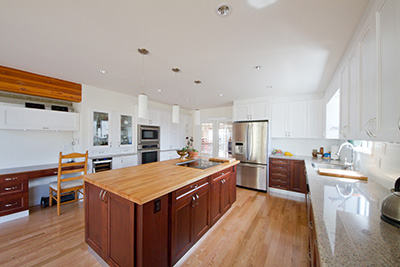
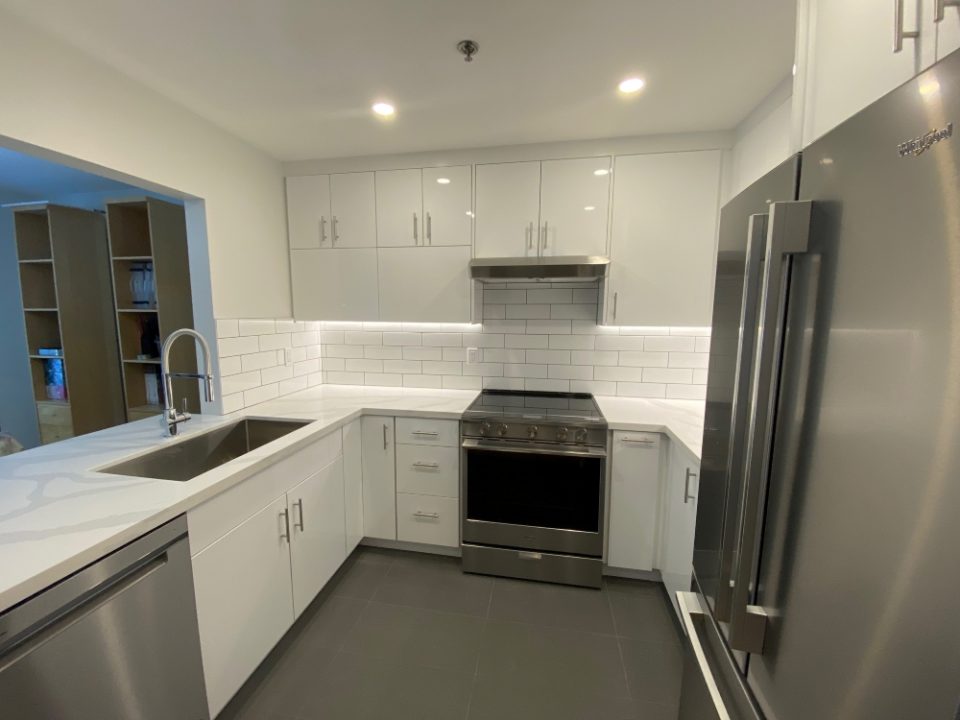
The kitchen is another focal point in K Residence.  White marbled countertops are harmoniously set against luminous white tile and cabinets which are perfectly offset by the warm wood flooring and stainless steel appliances.  Feature cabinets include window panels and help to create an unassuming and homey feel in a space that is equally refined and practical.

Without question, every detail was considered in remodelling K Residence.  In the end, the home delivers a unique combination of worldly class and style without compromising the livability of the space.  All the modern conveniences have been accounted for including a gas fireplace set between large shelving units, baseboard heating, and beautifully expansive decks to make the most of outdoor living.  At K Residence, homeowners wanted to enjoy every comfort in a home that screams unprecedented style – it was no small feat to achieve, but the finished product was certainly a success.

Kitchen Renovation Costs in Vancouver

A kitchen renovation can revitalize your home. As one of the most important rooms in your home, the kitchen is a place where families and their friends come together.  From daily meal preparations and dinner parties to homework time at the kitchen table, a bright and pleasing kitchen can have a huge impact on your day.  So, whether you are considering renovating your kitchen because its style is outdated or its fixtures and features are showing signs of aging, you probably have a lot of questions about kitchen renovation costs in Vancouver.  Let’s take some time to address those questions.

First, it’s important to understand that kitchen renovation costs can vary widely from one home to another.  In fact, kitchen renovation costs are impacted by a wide variety of factors from the costs of labour in Vancouver to the materials you use and will even depend on the size and scope of your project.  For these reasons, it is vital that you clearly plan every step of your kitchen renovation.  Start with a checklist of what you need to do – some renovations include a complete overhaul of cabinets, appliances, flooring and lighting while others are simple and may feature minor upgrades like new paint and a backsplash.  Ask yourself the following questions before you start budgeting for your renovation:

  • Can I salvage any materials or appliances from my current kitchen?
  • What are my “must-haves” and where can I compromise if necessary?
  • Where will my family stay during the kitchen renovation, and how will we prepare and store food?
  • Am I going to do the renovation on my own or will I need to hire a contractor?

Ultimately, once you have a clearer picture of the type of renovation you’re doing, you can start to organize your budget and plan the details of your renovation.  Remember, renovation costs can add up quickly, particularly in Vancouver where an active housing market often translates to increased labour costs.  On average, a kitchen renovation in Vancouver costs around $50,000 with high-end kitchen renovations easily exceeding $70,000.  If you start considering elements such as custom cabinetry, stainless steel appliances, marble or granite countertops, you’ll notice your renovation costs rise very quickly.

If you want to maintain a tighter budget for your kitchen renovation, there are ways to keep your costs in check.  Maintaining affordable kitchen renovation costs in Vancouver doesn’t need to be difficult – consider the current features of your kitchen and try to reuse as much as possible.  Keeping the same layout in your kitchen can also help you manage costs, as can refurbishing your current cabinets.  Another tip is laminate flooring or countertops which can still be very attractive and bring new life to your kitchen.

Why Remodelling Your Home Can Cost More

It seems everything costs exponentially more today than it did even 10 years ago. The price of food, heating, and energy has steadily risen over this time period and there are no signs of an end to rising costs. So then, it should not come as a surprise that remodeling your home will likewise cost more. But why? The impact of an expensive housing market, labour shortages, and material costs are just a few of the factors that influence the bottom line when it comes to remodelling your home. By delving a little deeper into each of these issues, you can begin to understand why remodelling your home will cost more today than in the past.

Housing Market

Today’s housing market is expensive and competitive. While there are fluctuations in market trends between and within geographic regions, experts note that particularly in popular areas, housing prices have increased significantly since the early 90s. Given the cost of purchasing a new home, many homeowners are opting to remodel their current home in an attempt to save money. This may or may not be an effective approach – experts point to labour shortages and rising materials costs as having a significant impact on the cost of a remodel.

Labour Costs

Speaking more specifically to labour and the obvious (and not-so-obvious) costs associated for remodelling, homeowners are commonly reporting that their budget for labour is much higher today. Additionally, many projects experience delays in completion which has an added impact on the budget for a remodel. For example, larger projects tend to be associated with even larger increases in costs. In 2018, homeowners remodeled their kitchen at a cost 10% higher than in 2016. In just one year, the median kitchen renovation increased by more than $3,000.

Materials

Similarly, material costs are steadily rising – likely because of increasing costs associated with manufacturing and transporting materials. Many homeowners indicate that though they set a strict budget at the outset of their remodel, almost one fifth of these projects came in over budget. And even this represents a significant jump from just 2 years ago where closer to 15% of kitchen and bathroom renovations ran over-budget. Industry professionals highlight the influence of material costs on budget overruns – in most remodelling projects, experts recommend factoring a contingency for unexpected costs into your budget, but with rising material costs it is much easier to overshoot even this contingency.

Nevertheless, the potential for an improved resale value on homes entices homeowners to undergo home remodelling projects. New homeowners see remodelling as a financial investment that also allows them to personalize their home; whereas, longstanding homeowners likely value the investment potential as well as an opportunity to revitalize their home.

How to Budget a House Renovation

Setting a budget is possibly one of the most important aspects of a home renovation.  Without a properly researched budget, costs can easily overrun what you can afford. More importantly, developing your budget can actually help you plan your house renovation.  So, how do you budget a house renovation?  Here are some tips.

Your Bottom Line

Ultimately, your budget will reflect what you can realistically afford – so start by asking yourself how much you have to spend. Whether you have money on hand, or you’re seeking financing, knowing your bottom line will guide all your budgeting plans.

Wants versus Needs

You might be renovating because you really want a new décor, a new room, or a new vibe; or, you may be renovating because things are in dire straits.  In most cases, a home renovation incorporates a little of both – your wants and your needs.  Before budgeting, make a clear list of all the things you absolutely need to achieve in the renovation and a list of items that are desirable but not necessary.

Once you have a sense of how you want your home renovation to unfold, start by getting a ballpark figure of costs.  For major upgrades to a bathroom, kitchen, or for additions, you’re generally looking at around $150 per square foot.  Working with a contractor or designer can help you nail down some of these more general figures.

Contractor Quotes

Unless you are a proficient DIY star, you’ll want to start researching various contractors in your area and get quotes for the work you want done.  Ask friends and colleagues for recommendations for contractors and do a bit of online research.  Once you have at least a trio of contractors identified, ask for information about their recent work (pictures speak a thousand words!) and check their references too!  After you have selected a contractor, add at least 15% to their quote for contingencies – there are always unexpected costs in home renovation projects.  ALWAYS.

Adjusting your Budget

You’ve already clarified what is necessary from what is desirable, so if your budget does not fit the project you’re considering, you’ll need to trim the fat.  You can start by seeking lower-cost alternatives, repurposing or keeping features/fixtures that are functional, or reducing the scope of your project.  Your contractor should also be able to help you identify ways to reduce your costs.

Remember, home renovations are costly and time consuming – by setting a budget in advance, you’ll find that a lot of the leg work gets done before your project begins.  Additionally, carefully researching your costs helps you make the right decisions for you and your family and also facilitates a smooth and stress free home renovation.

Home Renovation Tips

Home renovations can be stressful – they are time consuming, costly, and sometimes difficult to organize, especially for homeowners who do not have expertise with construction projects.  Still, regardless of the type, size, scope, or cost of your home renovation project, there are ways to make the process less stressful and more manageable.  Let’s take a look at a few home renovation tips that will help you keep your project in perspective.

Set a Budget

Not only do you need to set your budget, but you need to stick to it.  Regardless of how much money you have to spend, spending that money wisely and with purpose can help you achieve a successful home renovation project.  A small budget doesn’t need to equate to a cheap renovation, and vice versa.  So, when planning your project set your budget in advance and then make your choices based on what your budget allows.  When you are pricing fixtures and materials, for example, your budget will facilitate the choices that work best for you.  Your budget should include line items for everything you know your project will need from plumbing, countertops, and cabinets to flooring, lighting, and paint.  Also, always allow for at least 10% of your budget to cover unexpected costs – there most definitely will be unexpected expenses during your renovation.

Exercise Patience

You may want to get your home renovated today, but sometimes it makes more sense to wait until you have the budget and resources you need to ensure the project is completed to your satisfaction.  Even if money is no object, it’s advisable to plan your renovation project carefully and preferably with the assistance of experts.  Taking your time to properly plan your home renovation will ensure that you achieve a cohesive renovation that reflects your personal style and the functionality of the space.  Additionally, patience will allow you to carefully reflect on every detail of your renovation project and that can ultimately save you money in the long run.

Get Involved

Ok, you may not confidently manage certain aspects of your home renovation, but consider where you can do it yourself and where you’ll absolutely need the help of experts.  Particularly if you’re looking to save money, a DIY approach can make a huge difference.  Even small jobs like preparing a space or demolition and clean up are jobs that don’t require a lot of skill but can save money that can be better spent on other aspects of your renovation.  If you have more construction or design experience, you can likely contribute in other ways – but the take home message: if you can do it yourself, do it yourself!

Home renovations are exciting, confusing, fun, and stressful, but the end product can make it all worth it.  Follow these tips and home renovation is sure to go smoothly!

Bathroom Renovation Cost

Are you sitting down? On average, a bathroom renovation can cost upwards of $10,000.  Now that you’ve been sufficiently shocked, take a few deep breaths.  Bathroom renovation costs can vary significantly depending on many factors including the size and scope of the project, your style, and obviously your budget.  A minor renovation may cost as little as a few hundred dollars whereas a total overhaul with top-end features and fixtures can exceed $15,000.  So then, how can you calculate your bathroom renovation cost?

First, you need to carefully plan your renovation.  Whether you work with a general contractor or plan the renovation on your own, you need to account for every detail and carefully consider your budget before you begin a renovation.  While it may seem that working with a contractor will add to the cost of your renovation, they can also save you money.  Contractors will help guide your bathroom renovation project by asking the right questions and providing accurate cost estimates.  In fact, a contractor’s expertise can help you establish realistic expectations so that you get the bathroom you want for a price you can afford.

You bathroom renovation budget must include considerations of the size of your bathroom, the fixtures you need, materials involved, and whether floor plans or plumbing changes are necessary.  Obviously, using your current fixtures and using your current floorplan will be the most affordable approach to a bathroom renovation, but if you want a new tub, cabinets, toilet, and countertops, the cost of your renovation can add up quickly.  So then, what do you need to account for in developing a budget for your bathroom renovation?

A few features that may be included in your bathroom renovation are faucets, showers and bathtubs, flooring, countertops, cabinets, and lighting.  Additionally, plumbing and electrical work, construction, permits, and labour costs must be incorporated.  Of course, there is also a range of prices for each of these elements – on the low end of the price range a new bathtub may cost around $500-$800 installed whereas a high-end bathtub may cost upwards of $7,000 installed.  Pricing for cabinets can also range from as little as $1,000 to more than $10,000.  This all depends on the size of your bathroom, the quality of materials, and the labour fees involved.

Remember, you don’t always need to choose the most expensive fixtures for your bathroom, so carefully consider your budget and your vision when planning your bathroom renovation and you’ll likely find that you can remodel affordably.  You can even consider cost-saving approaches such as refinishing your current cabinets, painting your bathtub, and basically picking and choosing where to make the big changes.  By working with an experienced contractor, you can effectively plan your renovation so that you get a beautiful new bathroom no matter your budget.

Prebuilt Home or Build a New House?

When you are on the market for a new home, you essentially have two options – you can choose to build a custom home or you can look for prebuilt homes.  Obviously there will be pros and cons to each of these options, so it’s always helpful to gather some information first and then make the choice that’s right for you and your family.  Depending on your unique needs, your budget, and sometimes even your preferred neighbourhood, you will likely find that a prebuilt home or building a new house is more appropriate for you.

So, let’s start by discussing prebuilt homes.  One quick point of clarification should be made – a prebuilt home and a pre-fabricated home are not the same.  Pre-built homes are those in neighbourhoods that developers have constructed on site.  Pre-fabricated homes are those that feature parts that are manufactured in a facility and then shipped and assembled on the owner’s land.  Pre-fabricated homes will not be discussed here further as their construction differs significantly from prebuilt and custom built homes.

When it comes to prebuilt homes, costs can be significantly less than those associated with building a new home.  Prebuilt home prices include the cost of construction, appliances, and even landscaping, but your input or unique needs would not be considered in their construction.  Nevertheless, as the homeowner, you would have the option of renovating your home to meet your unique specifications if you can’t find a prebuilt home that suits your family.  That being said, renovation costs can be significant and may erase any savings you enjoy when purchasing prebuilt homes.

Another advantage of prebuilt homes is that they would be found in an established community; and quite often, they are in a neighbourhood with many other new, prebuilt homes.  This means you can evaluate the quality and character of the neighbourhood before you purchase the home.  And, as you would expect, prebuilt homes also come with the land they are built on which makes the process of securing your home a little more straightforward.

Alternatively, building your own home gives you total control over the build.  These are custom homes where you can work from the early design phases right up to determining the finishing touches on the home.  If you are looking to find your dream home, building your own home might be the best option for you.  Keep in mind however, there is a lot more work to be done and the process can be lengthy.  You have to secure the land on which the home will be built, hire architects, contractors, and other professionals, and you’re ultimately responsible for every decision in the construction process.  If you’re looking to get into a new home quickly, the custom route may not be best for you – but if you have a vision of your perfect home, building your own provides incredible flexibility and control.